
Feta Spinach Filo Pastry | The Complete Guide to a Timeless Mediterranean Classic
Feta Spinach Filo Pastry
Mediterranean Cuisine · Greek Recipes · Baking Guides
Feta Spinach Filo Pastry
Everything you need to know — from ancient origins to expert tips, foolproof recipes, creative variations, and the nutritional science behind every flaky, golden bite.
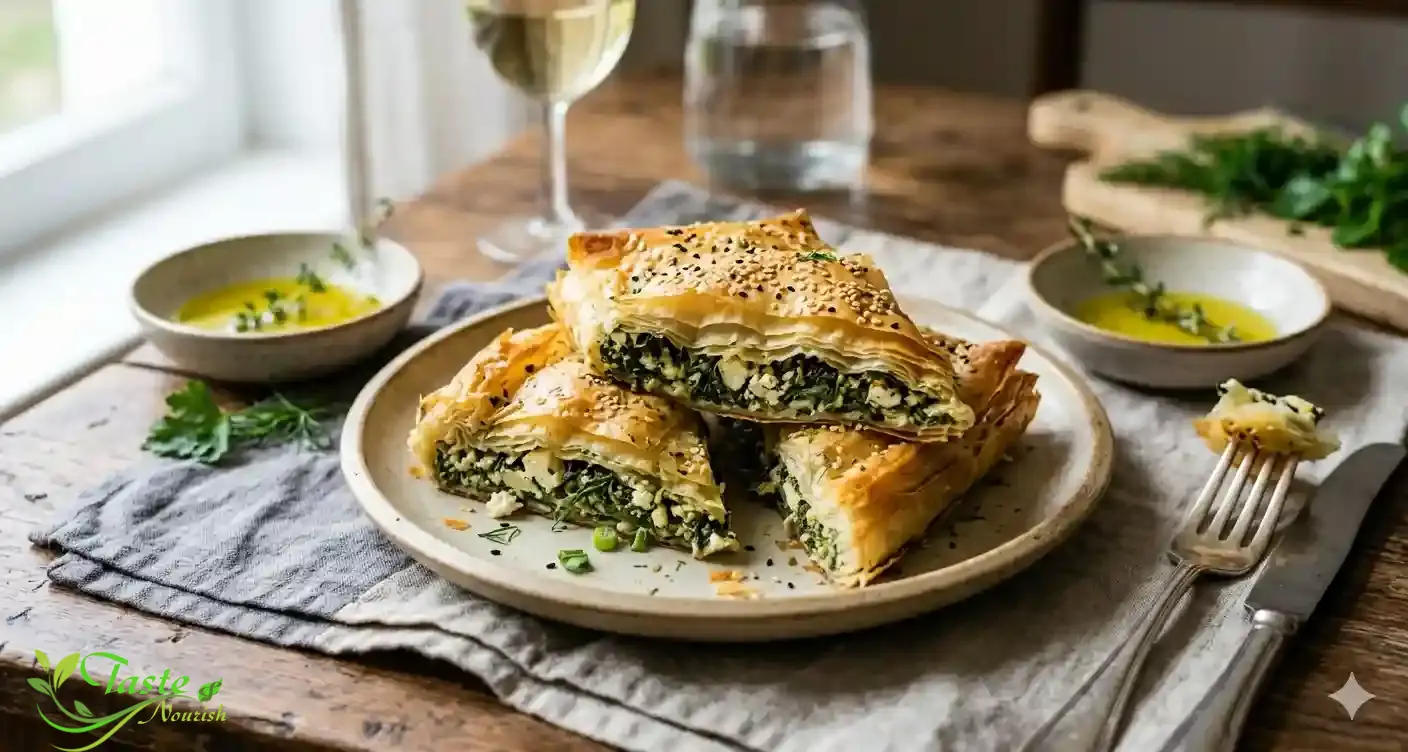
There are dishes that feed a crowd, and then there are dishes that define a culture. Feta spinach filo pastry — known across Greece as spanakopita — belongs firmly to the second category. With its impossibly thin, shatteringly crisp layers of golden pastry wrapped around a savory filling of wilted spinach, crumbled feta, and fragrant herbs, it occupies a place of honor in the Mediterranean culinary canon that few other dishes can claim.
Whether you have encountered it as a warm triangle from a Greek bakery at dawn, as a generous slab served at a family gathering, or as elegant finger food at a party, the experience is always the same: that first crackling bite followed by the soft, salty, herby interior is nothing short of revelatory. And yet, for all its drama on the plate, feta spinach filo pastry is a remarkably achievable dish for home cooks at any skill level.
This guide covers everything — the history, the science of filo, the sourcing of ingredients, a detailed recipe, expert troubleshooting advice, regional variations, nutritional data, and answers to the questions home cooks ask most. By the end, you will have everything you need to make this dish with confidence, consistency, and your own personal touch.
1. What Is Feta Spinach Filo Pastry?
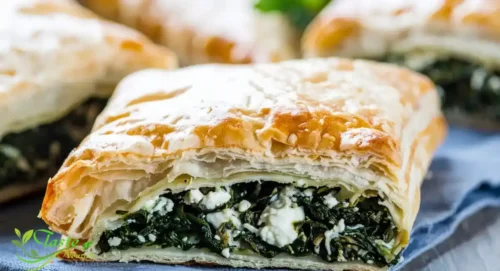
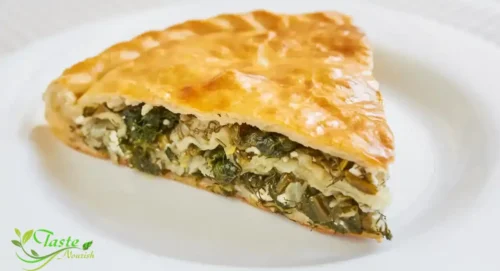
At its most basic, feta spinach filo pastry is a savory baked pie constructed from layers of paper-thin filo (also spelled phyllo) dough wrapped around or layered over a filling of cooked or wilted spinach and crumbled feta cheese. Eggs, fresh herbs such as dill and parsley, and aromatics like spring onions or garlic typically round out the filling, adding depth and structure.
The word filo (or phyllo) derives from the ancient Greek word for “leaf” — an entirely apt description for dough so thin that light passes through it. The name phyllo refers to the thin, flaky layers that make up the pastry, and this connection suggests a strong historical link to Greek cuisine. Each individual sheet is barely thicker than a piece of tissue paper, and it is precisely this extreme thinness — achieved through skilled stretching and rolling — that gives the pastry its signature airy crunch once baked.
The dish appears under several names depending on its form and regional origin. It is often called spanakotiropita in northern Greece, meaning “spinach-cheese pie,” while in southern Greece the term spanakopita is also common for versions with cheese. In Turkish cuisine, a very similar preparation is known as ıspanaklı börek. Across the Balkans and the broader Mediterranean, close cousins of this dish appear in bakeries and home kitchens from Sarajevo to Istanbul to Athens.
Quick Definition Spanakopita literally translates from Greek as “spinach pie” — from spanaki (spinach) and pita (pie). When feta cheese is included, it is sometimes more precisely called spanakotiropita, though the two terms are used interchangeably in everyday speech.
2. A Rich History: From Byzantine Kitchens to Global Tables
To understand feta spinach filo pastry fully, you need to follow two distinct ingredients — spinach and filo dough — through history until their paths finally converge into the dish we know today.
The Arrival of Spinach in Greece
Spinach originated in the Middle East, and merchants brought it to Spain. During the Byzantine Empire it arrived in the rest of Europe, and farmers in the area comprising present-day Greece discovered they could cultivate this leafy green very easily. Before spinach arrived, cooks in mountainous regions like Epirus relied almost entirely on wild foraged greens — dandelion, nettles, purslane, and chard — as the basis for their savory pies. The introduction of cultivated spinach gave cooks a reliable, productive, and versatile ingredient that integrated seamlessly into existing culinary traditions.
The Origins of Filo Dough
The origins of spanakopita can be traced back to the Byzantine Empire, where spinach and feta cheese were staple ingredients in many dishes. The filo dough, a key component of the pastry, was also widely used in Byzantine cuisine. The precise geographic origin of filo dough remains debated among food historians. Many believe the concept may have originated in ancient Turkey or the Middle East, where similar types of pastry were used in traditional dishes, and the pastry was likely introduced to Greece through the Ottoman Empire, where it was adapted and modified to suit local tastes and ingredients.
Phyllo is a basic dough made with flour, salt, water, olive oil, and sometimes yeast or another leavening agent. Like the arrival of spinach in Greece, phyllo emerged during Byzantine times, and with it came the pies that became a cornerstone of Greek cookery.
Spanakopita as Cultural Artifact
Beyond flavor, spanakopita was crafted with practicality in mind. In Greece’s rural regions, where men spent long days working in the fields, this pie became the perfect portable meal. Packed with protein-rich feta, hearty greens, and energy-sustaining phyllo, spanakopita could withstand the day without spoiling, providing essential nutrition in a compact form.
In Greece, spanakopita is more than just a dish — it is really more of an experience. It is enjoyed across Greece as a meze (snack), a side dish, or even as a main meal, and is a common feature at family gatherings, festive occasions, and church celebrations, symbolizing warmth, family, and abundance.
The dish has also evolved through the Greek diaspora. As Greek communities established themselves in Australia, the United States, Canada, and across Europe throughout the twentieth century, they carried their recipes with them. Today, the global spread of spanakopita is a testament to the power of cultural exchange and the enduring appeal of Greek cuisine.
Historical NoteOne of the earliest references to Greek spinach pies comes from the poet Philoxenos in the fifth century B.C. However, the spanakopita in the recognizable form we know — with filo dough and feta — most likely emerged during the Byzantine period (4th–15th century A.D.) when all three key elements finally coexisted in the Greek culinary landscape.
3. Why This Dish Has Endured for Centuries
It would be easy to attribute the popularity of feta spinach filo pastry simply to its taste — and its taste is extraordinary. But longevity in culinary tradition requires more than flavor alone. Several overlapping qualities explain why this dish has survived thousands of years of history and crossed dozens of international borders.
- Accessibility of ingredients. Spinach, feta, eggs, and filo pastry are widely available and affordable in most parts of the world today.
- Nutritional completeness. The combination of leafy greens, protein-rich cheese, and eggs makes it a genuinely nourishing meal, not just a snack.
- Versatility of form. It can be made as a large baked tray, individual triangle parcels, spiral rolls, bite-sized canapés, or hand-held street food.
- Adaptability to dietary needs. The dish is naturally vegetarian and can be made dairy-free or vegan for religious fasting periods — as it traditionally is in Greece during Lent.
- Make-ahead convenience. The filling can be prepared in advance, and the assembled pie travels and reheats beautifully.
- Impressive visual impact. The golden, crackling layers never fail to generate excitement when brought to a table, making it ideal for entertaining.
“Wherever you go in Greece, a warm slice of freshly made spinach and feta pie (spanakopita!) is never far away.”— Scrummy Lane Food Blog
4. Understanding the Ingredients
The quality of a feta spinach filo pastry depends entirely on understanding what each ingredient contributes — and how to choose the best version of each one.
Filo (Phyllo) Pastry
Store-bought filo pastry has made this dish accessible to home cooks worldwide. It is typically sold in the freezer section of supermarkets, rolled into a rectangular package. Pre-packaged frozen filo generally comes in two sizes: 9×14 and 13×17. The longer, narrower size of 13×17 is preferred for large pie dishes, offering more coverage per sheet.
The single most important rule with filo: keep it covered and work quickly. Filo dries out in minutes when exposed to air, becoming brittle and unworkable. Always keep the sheets you are not currently using under a lightly damp kitchen towel.
Spinach: Fresh vs. Frozen
Both fresh and frozen spinach produce excellent results, but they behave differently in the recipe.
| Spinach Type | Preparation Required | Best For | Key Tip |
|---|---|---|---|
| Fresh baby spinach | Wilt by squeezing with hands or briefly sautéing; drain thoroughly | More vibrant flavour, brighter colour | Squeeze out every drop of liquid |
| Regular fresh spinach | Remove tough stems, chop, wilt in pan, drain | Earthier, more robust flavour | Cool completely before mixing with cheese |
| Frozen spinach | Thaw fully, then squeeze out moisture aggressively | Convenience; consistent moisture content | Use a clean tea towel and squeeze in batches |
⇑ Spinach options compared for feta filo pastry.
Critical Warning Excess moisture is the number one cause of soggy filo pastry. Whether you use fresh or frozen spinach, squeezing out absolutely every drop of water is the single most important step in the recipe. Do not rush it.
Feta Cheese
Feta is the heart of the filling — the ingredient that provides saltiness, tang, creaminess, and structure. Feta is a Protected Designation of Origin (PDO) product, meaning that only cheese made in specific areas of Greece can be legally called “feta.” In these regions, feta is made with milk from sheep and goats raised on local grass, which gives the cheese its unique characteristics.
For this recipe, you have several choices:
- Authentic Greek feta (sheep/goat milk): The traditional choice, with a firm, crumbly texture and a sharp, tangy flavour. Highly recommended.
- Danish-style feta (cow’s milk): Creamier and milder in flavour. Works well if you prefer a less salty result.
- Goat’s feta: A nice twist, with a slightly more pronounced earthiness.
Regardless of which feta you choose, buy it in a block rather than pre-crumbled. Block feta retains more moisture, crumbles more evenly, and tastes significantly fresher.
Herbs and Aromatics
Fresh herbs are not optional — they are essential to the distinctive flavour of spanakopita. The most common choices are:
- Dill: The most iconic choice; provides a clean, slightly anise-like lift.
- Fresh parsley: Adds brightness and colour.
- Fresh mint: Used in some regional Greek recipes; gives a lovely aromatic freshness.
- Spring onions (scallions): Preferred over regular onions as they do not require pre-cooking and add a mild sweetness.
- Garlic: Optional but welcome; use sparingly.
- Nutmeg: A tiny pinch in the filling is a subtle but surprisingly transformative addition.
Fat for Brushing: Butter vs. Olive Oil
Both melted butter and good-quality olive oil produce excellent results, and many cooks use a combination of both for the best of each world. Filo dough is almost free of any fat; therefore, fat needs to be added to the dish prior to baking. Each layer of dough is brushed with melted butter, which not only adds fat content but also adds tremendous flavour and plays a vital role in creating the final crispy texture.
Extra virgin olive oil works beautifully and is the traditionally Greek choice. It produces a slightly lighter, less buttery result that lets the spinach and feta shine more prominently.
5. Step-by-Step Feta Spinach Filo Pastry Recipe
Classic Spinach and Feta Filo Pastry (Spanakopita)
A traditional Greek spinach and feta pie with crispy, golden filo pastry layers and a richly flavoured herby filling. Serves 6–8 as a main dish.
Ingredients
For the filling:
- 500g (about 17oz) fresh baby spinach, or 400g frozen spinach (fully thawed)
- 300g (10.5oz) authentic Greek feta cheese, crumbled
- 4 spring onions (scallions), finely sliced
- 3 large free-range eggs, lightly beaten
- Small bunch of fresh dill, roughly chopped (approx. 3 tablespoons)
- Small bunch of fresh parsley, roughly chopped
- 2 tablespoons fresh mint leaves, finely chopped (optional but recommended)
- 2 garlic cloves, finely minced (optional)
- Zest of 1 lemon
- Pinch of freshly grated nutmeg
- Freshly ground black pepper (feta provides sufficient salt — taste before adding any)
For the pastry:
- 270g (one standard pack) filo/phyllo pastry sheets, thawed
- 80g (6 tablespoons) unsalted butter, melted, OR 4–5 tablespoons extra virgin olive oil (or a mix of both)
- 1 tablespoon sesame seeds for topping (optional)
Method
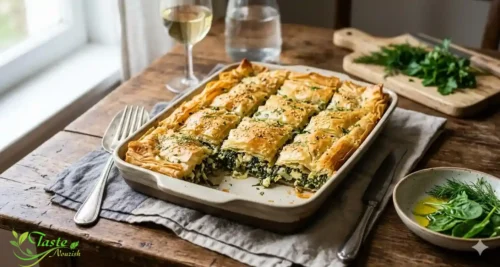
1-Prepare the oven and equipment. Preheat your oven to 200°C / 400°F / Gas Mark 6 (or 180°C fan). Lightly oil a 30×20cm (12×8 inch) baking dish or a large round pie dish. Have your melted butter or olive oil ready with a pastry brush.
2-Process the spinach. If using fresh spinach: place it in a large colander and sprinkle with a generous pinch of salt. Leave for 5 minutes, then squeeze the spinach firmly with your hands in batches until virtually no liquid remains. Chop roughly. If using frozen spinach: ensure it is fully thawed, then squeeze out moisture using a clean tea towel or your hands — this step is critical.
3 -Make the filling. In a large mixing bowl, combine the squeezed spinach, crumbled feta, spring onions, beaten eggs, dill, parsley, mint (if using), garlic (if using), lemon zest, and nutmeg. Season with black pepper. Mix gently but thoroughly. Taste the filling before adding any salt — feta is already quite salty.
4-Prepare the filo base. Lay a damp tea towel flat on your work surface to keep filo sheets covered while you work. Place one sheet of filo in the base of the prepared dish, letting any excess hang over the sides. Brush lightly with butter or oil. Repeat, adding 6–8 sheets total for the base, brushing each with fat as you go and alternating the direction of each sheet slightly so the overhanging pastry covers all sides of the dish.
5 -Add the filling. Spread the spinach and feta filling evenly over the base layers of filo. Use the back of a spoon to level the surface gently.
6 -Top with remaining filo. Layer 5–6 more filo sheets on top of the filling, brushing each sheet with butter or oil. Fold or scrunch the overhanging edges of the base filo sheets up over the top to create a sealed edge. Brush the top generously with butter or oil. Score the top layers lightly with a sharp knife into portion-sized pieces (this prevents the pastry from cracking when cut later). Sprinkle with sesame seeds if using.
7 -Bake. Bake in the preheated oven for 35–40 minutes, or until the top is deep golden and gloriously crisp. If the pastry colours too quickly, cover loosely with foil for the final 10 minutes.
8 -Rest and serve. Remove from the oven and allow to rest for at least 10 minutes before cutting — this lets the filling set and makes cleaner slices. Serve warm or at room temperature.
6. Pro Tips for Perfect Filo Pastry Every Time
Working with filo pastry is one of those skills that improves dramatically with a few key pieces of knowledge. Here are the techniques that separate a good spanakopita from an outstanding one.
Thawing Filo Correctly
Never try to rush-thaw filo in the microwave or oven. Transfer the package from the freezer to the fridge the night before you plan to cook. If you are pressed for time, leave it at room temperature for 2–3 hours in its original sealed packaging. Opening the packet before the dough has fully thawed leads to cracking and tearing.
Working With the Sheets
The golden rule: never let filo sheets sit uncovered. Keep them under a slightly damp (not wet) kitchen towel at all times, uncovering only the sheet you are actively working with. Filo exposed to air for even two or three minutes will become brittle and tear along the edges.
The Fat Application
You do not need to saturate every inch of every filo sheet with butter or oil — a light, even coat is sufficient. Think of it as moisturizing rather than drenching. An overly oily pastry will taste greasy; a lightly oiled one will be crisp and airy. Use a wide, soft pastry brush and apply the fat in broad, gentle strokes.
The Scoring Trick
Before baking, use a sharp knife to score the top layers of filo through to the filling in your desired portion shapes. This serves two purposes: it prevents the top pastry from shattering unpredictably when cut after baking, and it allows steam to escape during cooking, ensuring a crisper top.
Managing Moisture in the Filling
The enemy of crisp filo is steam generated by a wet filling. Beyond squeezing the spinach thoroughly, you can also add a small amount of dried breadcrumbs (2 tablespoons) to the filling to absorb any remaining moisture. Additionally, avoid over-mixing the filling after adding the eggs, as excessive agitation releases more liquid from the spinach.
Pro Chef Tip For an extra-crispy base, pre-warm the base of your dish on the stovetop for a few minutes before adding the filling. If using a cast-iron skillet, this ensures the crust will be more golden and ensures the bottom layers cook through properly.
Brushing the Top
The top layer deserves the most generous brushing. A well-buttered top is what produces that stunning deep amber colour in the oven. You can even give it a second brush of butter halfway through baking if you want an especially rich colour.
Resting After Baking
Cutting into feta spinach filo pastry straight from the oven is tempting but counterproductive. The filling needs 10–15 minutes to settle and firm up after the heat is removed. Cutting too soon causes the filling to crumble out of the slices rather than holding its shape cleanly. This resting time also allows the filo to move from dangerously hot to pleasingly warm.
7. Creative Variations & Regional Twists
One of the great pleasures of this dish is how generously it accommodates creative adaptation. Once you have mastered the core technique, the variations available to you are practically endless.
Spiral Pie (Soufra)
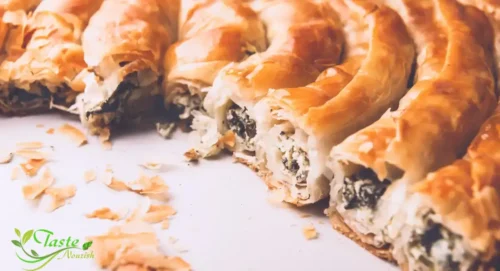
Roll each filo sheet into a cigar shape around the filling, then coil the rolls into a large spiral in a round baking dish. The filling doesn’t require any cooking, making it quicker and easier to prepare. The spiral shape gives a more dramatic presentation and a higher filo-to-filling ratio for extra crispiness.
Triangle Parcels (Tiropitakia)
Cut filo sheets into long strips and fold a spoonful of filling inside each strip in a triangular flag-folding motion. Ideal for parties, picnics, and appetizers. Spanakopita can be made in the form of hand pies shaped in triangles or even rolls.
With Ricotta or Cottage Cheese
Blend half the feta with an equal amount of ricotta for a creamier, lighter filling. This is a great option for those who find straight feta a little too salty, and it produces a noticeably silkier interior texture.
With Sun-Dried Tomatoes
Sun-dried tomatoes are a wonderful addition to the filling. They add a sweet-savoury depth and a gorgeous pop of colour that contrasts beautifully with the dark green spinach.
With Pine Nuts
Toasted pine nuts stirred through the filling add richness, crunch, and a subtle nuttiness that complements the salty feta beautifully. Toast them in a dry pan until golden before adding.
Vegan / Lenten Version
To honour the traditional Greek fasting version, omit the eggs and dairy feta entirely. Use a firm crumbled tofu seasoned with lemon juice, salt, garlic powder, and nutritional yeast in place of the feta. Brush filo sheets with olive oil rather than butter. The result is surprisingly satisfying.
With Leek & Fennel
Replace half the spinach with thinly sliced leek (sautéed until soft) and fennel fronds. This variant has a more complex, slightly anise-like flavour profile that pairs beautifully with feta’s sharpness.
Individual Muffin Tin Cups
Press small squares of filo into the cups of a greased muffin tin, fill with the spinach-feta mixture, and top with a ruffled filo square. Bake until golden. Perfect for buffets, children’s parties, or as a starter course.
| Variation | Key Addition/Change | Best Served As | Skill Level |
|---|---|---|---|
| Classic tray bake | Standard recipe as written | Main course, family meal | Beginner |
| Spiral (soufra) | Rolled & coiled filo | Centrepiece, sharing platter | Intermediate |
| Triangle parcels | Individual folded triangles | Appetizers, party food | Intermediate |
| With ricotta blend | Half feta, half ricotta | Main course (milder, creamier) | Beginner |
| Vegan / fasting | No eggs or dairy | Plant-based main, Lenten meal | Beginner |
| Muffin tin cups | Individual portions | Starter, buffet, finger food | Beginner |
| With leek & fennel | Leek + fennel added | Sophisticated dinner party | Intermediate |
⇑ Overview of popular feta spinach filo pastry variations.
8. Nutritional Profile & Health Benefits
Feta spinach filo pastry is genuinely nourishing, not merely indulgent. The combination of leafy greens, protein-rich cheese, and eggs delivers a meaningful spread of micronutrients alongside its satisfying macros. Below is an approximate breakdown per serving, based on a recipe serving 8 people.
| Nutrient | Amount per Serving (approx.) | % of Daily Reference Intake |
|---|---|---|
| Calories | 320–380 kcal | 16–19% |
| Protein | 10–14g | 20–28% |
| Total Fat | 20–24g | 28–34% |
| Saturated Fat | 8–10g | 40–50% |
| Carbohydrates | 22–28g | 8–11% |
| Dietary Fibre | 2–3g | 8–12% |
| Calcium | 250–300mg | 25–30% |
| Iron | 2.5–3.5mg | 17–25% |
| Vitamin A | 3,500–5,000 IU | 70–100% |
| Sodium | 450–680mg | 20–30% |
⇑ Estimated nutritional values per serving. Values vary based on exact ingredients and portion size. Sources: Supergolden Bakes; IGA Recipes.
The Health Benefits of Feta
Feta cheese contains more calcium than many other cheeses. Calcium helps maintain healthy teeth and bones. Feta also has high levels of phosphorus, and consuming phosphorus and calcium together has been linked to improved bone density and osteoporosis prevention.
Feta has been shown to contain Lactobacillus plantarum, which accounts for about 48% of its bacteria. These bacteria can help promote immune system and gut health by protecting the intestinal tract from disease-causing bacteria, and they seem to increase the production of compounds that inhibit the inflammatory response, providing anti-inflammatory benefits.
Feta’s vitamin B12 supports normal energy metabolism and helps maintain a healthy blood and nervous system. The natural fats in feta also help the body absorb fat-soluble vitamins like A, D, E, and K, making it a great topping for vegetable dishes.
One important consideration: feta has a fatty acid known as conjugated linoleic acid (CLA), and experimental studies have shown that CLA can help reduce body fat and improve body composition in the long term. However, feta is also relatively high in sodium, and pregnant women should be sure to avoid unpasteurized feta.
The Health Benefits of Spinach
Spinach is one of the most nutrient-dense leafy vegetables on earth. A single serving provides substantial quantities of:
- Vitamin K: Critical for blood clotting and bone metabolism.
- Vitamin A (as beta-carotene): Essential for vision, skin health, and immune function.
- Folate: Particularly important for pregnant women and foetal development.
- Iron: Important for red blood cell production; particularly valuable combined with the vitamin C content of herbs and lemon zest in this recipe, which enhances iron absorption.
- Magnesium: Supports muscle function, nerve transmission, and energy metabolism.
- Antioxidants: Including lutein, zeaxanthin, and quercetin, which protect cells from oxidative damage.
Key Takeaway Feta spinach filo pastry is not merely comfort food — it is a nutritionally meaningful dish that delivers significant calcium, protein, iron, vitamin A, and beneficial probiotics in every serving. Enjoyed as part of a balanced Mediterranean diet, it represents a genuinely health-supporting meal.
9. Storage, Freezing & Reheating
Understanding how to store and reheat this dish properly protects the one thing that makes it so irresistible: the crispy filo pastry.
| Method | How Long | Instructions | Pastry Quality |
|---|---|---|---|
| Room temperature (same day) | Up to 4 hours | Cover loosely; do not wrap tightly | Excellent |
| Refrigerator (cooked) | Up to 5 days | Store in airtight container | Good after reheating |
| Oven reheat | 15 min at 180°C | Place directly on oven rack or tray | Very good — restores crispness |
| Air fryer reheat | 5 min at 170°C | No preheating needed | Excellent — fastest crispy result |
| Microwave | Not recommended | — | Poor — pastry becomes soggy |
| Freezer (unbaked, assembled) | Up to 3 months | Wrap tightly in cling film then foil; bake from frozen adding 10–15 min | Very good |
⇑ Storage and reheating options for feta spinach filo pastry.
Practical Tip Spinach filo pie is best eaten fresh from the oven for the most crispy filo. If you plan to make it ahead for a gathering, assemble the pie up to 24 hours in advance (without baking), store it covered in the fridge, and bake it fresh on the day.
For make-ahead purposes, note that the filling can be prepared and refrigerated up to two days in advance. Assemble with filo only on the day of baking for the best results. If you are freezing an already-baked pie, accept that the pastry will be slightly less crisp after reheating — still delicious, but different in texture from freshly baked.
10. Serving Suggestions & Pairing Ideas
Feta spinach filo pastry is remarkably versatile in how it fits into a meal. It can anchor a table as the main dish or play a supporting role alongside other dishes. Here are the pairings and presentations that work best.
As a Main Course
Serve generous slices with a crisp green salad dressed simply with olive oil, lemon juice, and dried oregano. A bowl of tzatziki (strained yogurt, cucumber, garlic, and dill) on the side adds a cool, creamy contrast to the warm, salty pie. Roasted cherry tomatoes or a simple Greek salad (horiatiki) with olives, cucumber, and red onion round out the meal beautifully.
As an Appetizer or Meze
Cut into small squares or serve as triangle parcels with toothpicks. Pair with hummus, baba ghanoush, olives, and warm flatbread for a full Mediterranean meze spread. A glass of crisp white wine — Assyrtiko from Santorini or a Greek Moschofilero — is the ideal accompaniment.
For Picnics and Packed Lunches
Feta spinach filo pastry travels exceptionally well and is equally delicious at room temperature. Pack it with a small container of Greek yogurt, cherry tomatoes, and some olives for a complete and satisfying outdoor meal.
Brunch
Served warm with a fried or poached egg on top, alongside a simple cucumber and tomato salad and strong Greek coffee, feta spinach filo pastry makes a truly outstanding brunch centrepiece — particularly for entertaining a crowd.
| Occasion | Best Form | Ideal Accompaniments |
|---|---|---|
| Family dinner | Large tray bake | Greek salad, tzatziki, warm bread |
| Dinner party starter | Triangle parcels | Hummus, olives, white wine |
| Picnic / outdoor | Pre-cut squares | Cherry tomatoes, olives, fruit |
| Brunch | Slices or individual cups | Fried egg, cucumber salad, coffee |
| Party buffet | Muffin tin cups or triangles | Meze platter, dips, crudités |
| Meal prep / weeknight | Tray bake portions | Simple green salad, roasted tomatoes |
⇑ Serving suggestions by occasion.
11. Frequently Asked Questions
Can I use frozen spinach instead of fresh?
Absolutely. You can use frozen spinach — defrost it first and give it a good squeeze in a tea towel to remove any excess moisture. In fact, for large quantities, frozen spinach is often the more practical choice since a vast amount of fresh spinach wilts down to a surprisingly small volume.
Why is my filo pastry soggy?
The most common cause is excess moisture in the spinach filling. Always squeeze the spinach as thoroughly as possible — aim to remove every last drop of liquid before mixing with the cheese. Other causes include using too much fat on the sheets, not preheating the oven fully, or cutting into the pie before it has rested and the steam has dissipated.
How do I prevent filo from tearing?
Keep unused filo sheets under a slightly damp (not wet) kitchen towel at all times. Work with one sheet at a time, handling them gently and deliberately. If a sheet tears, simply layer it over the tear — in a multi-layered pastry, small imperfections are invisible in the finished dish and have no impact on taste.
Can I make this dish ahead of time?
Yes. You can make a spinach and feta filo pastry pie up to a couple of hours in advance — it doesn’t need to be served piping hot. For longer advance preparation, make the filling the day before and refrigerate. Assemble with filo on the day of baking. Alternatively, assemble the entire pie, refrigerate overnight unbaked, and bake fresh before serving.
Is feta spinach filo pastry suitable for vegetarians?
Yes, it is vegetarian. Traditional feta contains animal rennet, so strict vegetarians may wish to seek out a vegetarian-certified feta alternative. The dish is not vegan in its standard form, but a fully plant-based version using seasoned tofu instead of feta and olive oil instead of butter is easily achieved.
Can I add other cheese to the filling?
Yes — this is a wonderful way to adjust the flavour and texture. Ricotta or cottage cheese blended with feta creates a creamier interior. Grated Cheddar added to the mix contributes an extra richness and melting quality. Greek kefalotiri (a firm, salty sheep’s milk cheese) is another traditional addition in some regional recipes.
What temperature should I bake feta spinach filo pastry at?
Most recipes agree on 180–200°C (360–400°F). A higher temperature (200°C) produces the most dramatically golden, crisp pastry but requires close monitoring in the final 10 minutes to prevent over-browning. A slightly lower temperature (180°C fan) gives a more even bake with less risk of scorching.
How many layers of filo should I use?
For a traditional tray-baked spanakopita, 6–8 base layers and 5–6 top layers is the standard. Each layer contributes to crispness and structural integrity. Fewer layers will work but will produce a more delicate, less substantial crust. More layers are never a problem — they simply add more crunch.
Sources & Further Reading
- VJ Cooks — Spinach Filo Pie Recipe — Recipe technique and storage guidance.
- The Mediterranean Dish — Classic Spanakopita Recipe — Traditional preparation method and tips.
- WebMD — Feta Cheese: Is It Good for You? — Nutritional analysis and health benefits of feta.
- Healthline — Feta Cheese: Good or Bad? — Evidence-based review of feta nutrition.
- US Dairy — Is Feta Cheese Good for You? — Vitamin B12 and fat-soluble vitamin absorption data.
- My Sweet Greek — Spanakopita History — Historical origins of the dish.
- Wikipedia — Savory Spinach Pie — Cultural and geographic context across the Mediterranean.
- Supergolden Bakes — Spiral Spanakopita Recipe — Nutritional data and spiral variation method.
- Fly Me to the Moon Travel — Spanakopita: Greece’s Iconic Spinach and Cheese Pie — Cultural role in Greek society and hospitality.
- Scrummy Lane — Greek Spinach and Feta Filo Pie — Ingredient sourcing advice and make-ahead tips.
This article was written for informational and culinary guidance purposes. Nutritional values are approximate and will vary based on specific ingredients and portion sizes. For personalised dietary advice, consult a registered dietitian.