
Basbousa with Cream | The Irresistible Semolina Cake You Need to Know
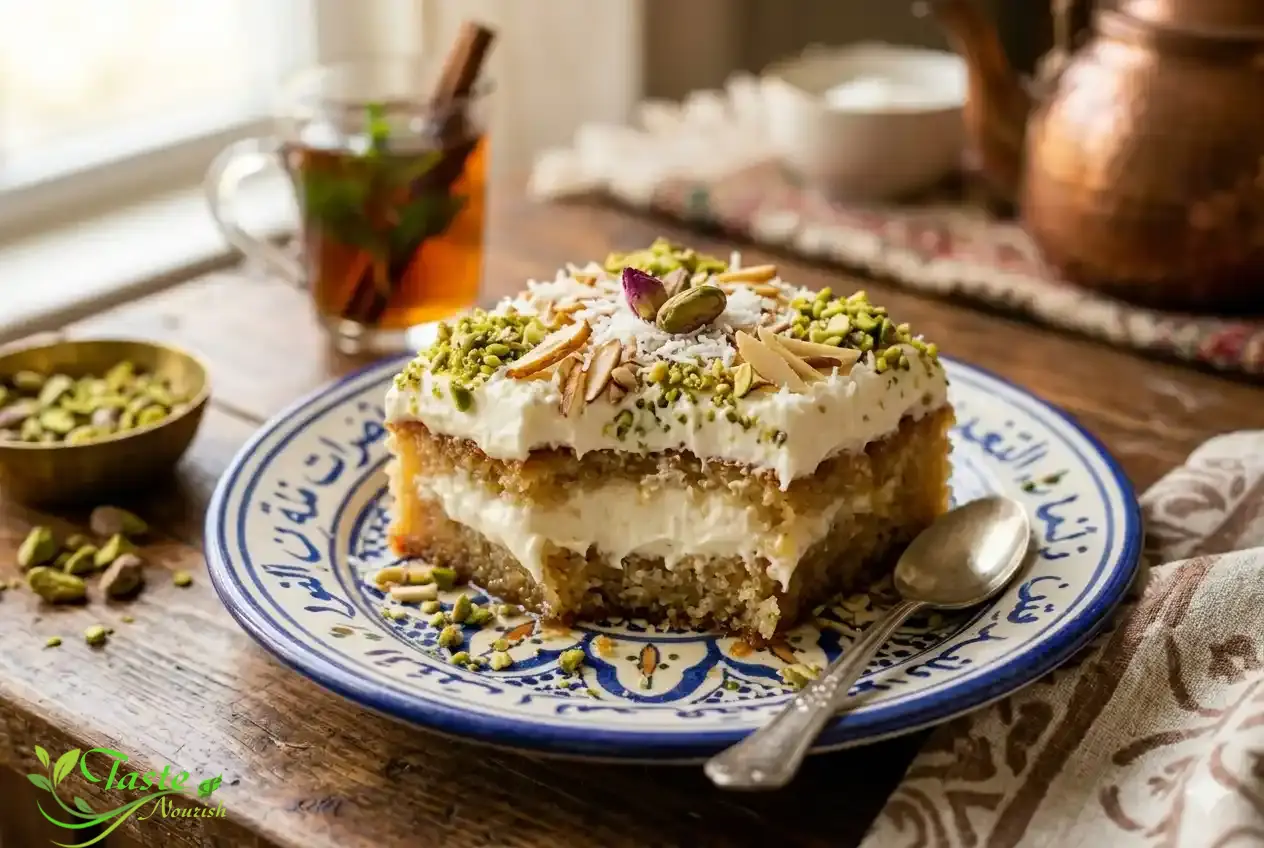
Basbousa with Cream
From its Egyptian roots to its starring role on Ramadan tables across the Arab world, basbousa with cream is more than a dessert — it’s a tradition. Here is everything you need to master it.
What Is Basbousa with Cream?
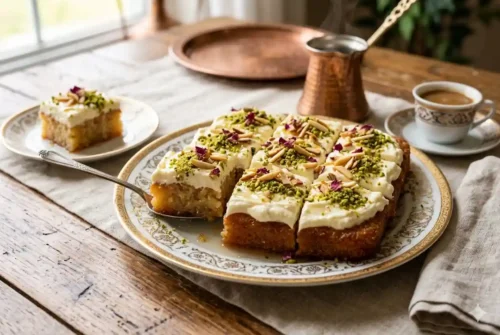
Unlike its plainer cousin, which is typically sliced into small diamond shapes and served casually, basbousa with cream tends to be a more occasion-worthy dessert. You will find it at Eid gatherings, Ramadan iftars, engagement parties, and family celebrations across Egypt, Lebanon, the Gulf states, and the wider Arab diaspora worldwide.
Key Takeaway
- Basbousa with cream is a layered semolina cake with a creamy filling, soaked in flavored sugar syrup.
- It differs from plain basbousa by including a distinct cream layer that adds richness and textural contrast.
- It is widely consumed during Ramadan, Eid, and special occasions across the Middle East.
- The Arabic name basbousa bil qishta directly translates to “basbousa with cream.”
History & Cultural Significance
Understanding basbousa with cream requires first understanding basbousa itself — and that story stretches back centuries across multiple civilizations. The dessert is widely attributed to Egyptian origins, where it has been documented as a staple sweet since at least the Ottoman era. Known as harissa in some regions and revani in Turkey and Greece, the semolina cake represents one of the great shared culinary heritages of the Mediterranean and Middle East.
Semolina — the coarse-ground flour from durum wheat at the heart of basbousa — has been a staple food ingredient in North Africa and the Levant for thousands of years. Ancient Egyptians used semolina in porridges and baked goods, and the tradition of soaking baked goods in honey or sugar syrup has deep roots in the region’s culinary history. What we recognize today as basbousa likely crystallized as a distinct recipe during the Mamluk and Ottoman periods, when refined sugar became more widely accessible across Egypt and the Levant.
The cream-filled variation emerged as a modern premium interpretation — one that likely gained widespread popularity in the 20th century as refrigeration made it practical to incorporate dairy-based fillings into baked goods. Today, the cream-filled version is arguably more popular than the original in many Gulf countries, where hospitality culture places enormous cultural value on richness and generosity of flavor.
The cultural significance of basbousa with cream extends far beyond its flavor. In many Arab households, it is a marker of care and effort. Preparing it from scratch — making the ashta cream by hand, layering the batter carefully, timing the syrup perfectly — is an act of love directed toward family and guests. Its appearance on a table communicates welcome, abundance, and festivity. It is, in the truest sense, a hospitality dessert.
Key Ingredients Explained
The quality and character of your basbousa with cream depend almost entirely on understanding what each ingredient contributes. This is not a dish where substitutions are always inconsequential — some ingredients are structural, others are flavor-critical. Here is a complete breakdown:
The Semolina Layer
| Ingredient | Role | Notes & Substitutions |
|---|---|---|
| Semolina (coarse or fine) | Primary structure; gives the cake its signature grainy, moist texture | Coarse semolina produces a more textured bite; fine semolina gives a softer crumb. You cannot substitute wheat flour entirely — the result will be an entirely different cake. |
| Sugar | Sweetens the batter; contributes to browning | White granulated sugar is standard. Honey or date syrup can replace it for a more complex flavor profile. |
| Yogurt | Adds moisture and a subtle tang; tenderizes the crumb | Full-fat yogurt is preferred. Its acidity helps activate baking powder and keeps the semolina from tasting flat. |
| Eggs | Bind the batter; contribute richness and structure | Use room-temperature eggs. Some recipes omit eggs, yielding a denser, chewier texture. |
| Oil or Butter / Ghee | Fat; contributes moisture and flavor | Neutral oil produces a lighter texture. Butter or ghee adds a richly savory, nutty dimension that many cooks prefer for authenticity. |
| Baking Powder | Leavening; creates a lighter, more risen layer | Some recipes add a splash of white vinegar alongside baking powder for extra lift. |
| Vanilla Extract | Aromatic; rounds out the sweetness | A full packet of vanilla sugar (common in Arab baking) or 1 tsp extract. |
| All quantities are specified in the recipe section below. | ||
The Cream Filling
The cream is where basbousa with cream earns its distinction. There are several approaches, each yielding subtly different results:
| Cream Type | Texture | Flavor | Ease |
|---|---|---|---|
| Qishta (clotted cream) | Thick, spreadable, dense | Rich, slightly tangy, milky | Very easy (ready-made) |
| Table cream (canned) | Smooth, fluid when warm, sets when cold | Mild, neutral, lightly sweet | Easiest |
| Ashta (homemade) | Silky, pudding-like, custard body | Delicate, floral if scented, most complex | Moderate (requires cooking) |
| Ricotta cheese | Grainy yet creamy | Mild, slightly salty | Easy |
| Cream cheese blend | Dense, tangy | Rich, savory-sweet | Easy |
The Sugar Syrup (Atar / Qatr)
The syrup is the soul of basbousa. Poured hot or warm over the freshly baked cake, it permeates the semolina layers and creates the characteristic moistness that makes basbousa so irresistible. A standard syrup is made from sugar and water in a 2:1 ratio, simmered with a squeeze of lemon juice to prevent crystallization, and optionally scented with rose water, orange blossom water, or a few cardamom pods.
The Complete Basbousa with Cream Recipe
This recipe is designed to be reliable, deeply flavorful, and accessible to home cooks of all levels. It uses a two-stage baking method — partially baking the first semolina layer before adding the cream — which ensures the cream stays perfectly nestled between two distinct, golden layers without melting into the batter.
Classic Basbousa with Cream (Basbousa Bil Qishta)
For the Semolina Batter
- 2 cups (320g) coarse semolina
- ½ cup (100g) white granulated sugar
- 1 cup (230g) full-fat plain yogurt
- 2 large eggs, room temperature
- ½ cup (120ml) neutral vegetable oil (or melted butter)
- ½ cup (120g) canned table cream or qishta — mixed into batter
- 2 tsp baking powder
- 1 tsp pure vanilla extract
- Pinch of salt
For the Cream Filling
- 1½ cups (350g) thick cream or qishta (canned or ready-made)
- 1 tsp rose water(optional, highly recommended)
- ½ tsp orange blossom water(optional)
For the Sugar Syrup (Atar)
- 1½ cups (300g) white sugar
- ¾ cup (180ml) water
- 1 tsp fresh lemon juice
- 1 tsp rose water or orange blossom water
For Garnish
- 3 tbsp crushed pistachios
- 2 tbsp slivered almonds(optional)
- Shredded coconut(optional)
Method
-
Make the syrup first. Combine sugar, water, and lemon juice in a saucepan. Bring to a boil over medium-high heat, stirring to dissolve the sugar. Reduce heat and simmer for 8–10 minutes without stirring, until slightly thickened. Remove from heat, stir in the rose water or orange blossom water, and allow to cool completely. The syrup must be fully cooled before use.
-
Prepare the batter. In a large bowl, beat eggs with sugar until lighter in color, about 1 minute. Add the yogurt, oil, and canned cream (if using in batter). Mix until combined. Add semolina, baking powder, vanilla, and salt. Stir until just combined — do not overmix. Let the batter rest for 15 minutes. This is important: resting allows the semolina to hydrate and the batter will thicken slightly, resulting in a more consistent, tender cake.
-
Preheat and prepare the pan. Preheat your oven to 180°C (350°F) with the rack positioned in the lower third of the oven. Grease a 9×13 inch (or 9×9 inch for a thicker cake) baking dish generously with tahini, ghee, or butter. Tahini is the traditional choice — it adds a subtle nutty flavor and releases the cake cleanly.
-
First bake. Pour half the semolina batter into the prepared dish and spread evenly with a spatula or wet palm. Bake for 12–15 minutes, until the top surface is just dry to the touch and lightly set, but not golden yet. The goal is a par-baked base — firm enough to support the cream, not fully cooked.
-
Prepare the cream layer. While the first layer bakes, stir together the thick cream (qishta), rose water, and orange blossom water in a small bowl. The mixture should be smooth and spreadable. If your cream is very thick, a gentle stir is all that is needed. Keep it cold until you are ready to use it.
-
Add the cream. Remove the pan from the oven and allow it to cool for 5 minutes. Spread the cold cream filling evenly over the par-baked base in a smooth, even layer, reaching all the way to the edges.
-
Top layer. Gently dollop the remaining semolina batter over the cream. Using the back of a wet spoon or an offset spatula, spread it carefully to completely cover the cream. Work slowly — the cream will try to push the batter around. Alternatively, use a piping bag to lay the batter in strips across the cream, then gently smooth.
-
Final bake. Return the pan to the oven and bake for 25–30 minutes, until the top is deep golden brown and the edges have pulled away slightly from the sides. The color of the top is your best indicator — it should be genuinely golden, not pale.
-
Syrup soak. Remove the basbousa from the oven immediately. While it is still very hot, pour the cooled syrup evenly and slowly over the entire surface. You will hear a satisfying hiss. Use all the syrup — the cake will absorb it as it cools. Do not be alarmed if it seems like a lot; semolina is extraordinarily absorbent.
-
Rest, garnish, and serve. Allow the basbousa to rest at room temperature for 30 minutes, then refrigerate for at least 1.5 to 2 hours before cutting. Chilling allows the cream to set firmly and the syrup to distribute evenly throughout. Before serving, sprinkle with crushed pistachios and any additional garnish. Cut into squares or diamond shapes.
A Deeper Look at Cream Types for Basbousa
The type of cream you choose will significantly influence the final flavor and texture of your basbousa. Each option has its advocates, and each has genuine merit. Here is a guide to help you choose based on your goals, availability, and experience level:
Ready-Made Qishta or Table Cream
This is the most accessible option in most Middle Eastern households and diaspora communities. Brands like KDD (in the Gulf), Puck, President, or supermarket-brand canned table cream all work well. The cream comes pre-sweetened and stabilized, making it foolproof. It holds its layer during baking without melting excessively into the surrounding semolina. The flavor is mild, milky, and lightly sweet — a perfect neutral canvas for the aromatic syrup.
Homemade Ashta Cream
Ashta is a traditional Levantine clotted cream made by heating full-fat milk with a small amount of starch, semolina, or flour to thicken it into a rich, pudding-like consistency. When made from scratch, ashta has a depth and delicacy that no canned product can fully replicate. The process takes about 15 minutes but requires constant stirring to prevent lumps. A classic ashta recipe combines whole milk, heavy cream, a tablespoon each of semolina and cornstarch, and a small amount of sugar, cooked over medium heat until thick.
Cream Cheese–Based Filling
A more Western-influenced variation, this approach blends soft cream cheese with heavy cream and a touch of sugar to create a tangy, dense filling. When stirred into a hot milk-and-starch mixture, it melts into a smooth, luxuriously rich cream. This variation is particularly popular among Arab-diaspora home cooks who want a more robust, cheesecake-adjacent flavor profile.
Choosing Your Cream
- For speed and reliability: Use canned thick cream or qishta straight from the package, mixed with a touch of rose water.
- For the most authentic flavor: Make homemade ashta using milk, cream, semolina, and cornstarch.
- For richness and tang: Use a cream cheese–based filling.
- For a lighter result: Ricotta thinned slightly with cream makes an excellent, less calorie-dense alternative.
Popular Variations of Basbousa with Cream
One of the beauties of basbousa with cream is how generously it accommodates variation. Once you understand the core structure — semolina batter, cream filling, sugar syrup — you can adapt it in dozens of directions. Here are some of the most beloved regional and creative variations:
Classic
Egyptian-Style Basbousa
Dense, rich, and heavily syrup-soaked. Uses yogurt and a high ratio of fine semolina. The cream layer is thick and generous. Typically scented with vanilla only, letting the semolina flavor speak clearly.
Gulf Style
Khaleeji Cream Basbousa
Lighter in color and somewhat airier. Often incorporates coconut flakes into the batter. The syrup is heavily scented with rose water and sometimes saffron. Garnished abundantly with crushed pistachios.
Levantine
Lebanese Basbousa bil Ashta
Uses homemade ashta cream (the Lebanese version, sometimes with mastic), and a syrup scented with orange blossom water rather than rose water. Has a more subtle, floral character throughout.
Modern
Coconut Cream Basbousa
Replaces dairy cream with full-fat coconut cream for a dairy-free alternative. The coconut adds tropical richness and a faintly sweet, nutty note that pairs beautifully with a cardamom-scented syrup.
Fusion
Chocolate Basbousa with Cream
Adds cocoa powder to one or both semolina layers for a dramatic marbled or double-chocolate effect. The cream filling cuts through the intensity of the chocolate with its milky sweetness.
Light
Sugar-Reduced Basbousa
Replaces sugar in batter and syrup with honey or date syrup for a more natural sweetness. Uses half the usual syrup quantity. Popular among health-conscious bakers who still want authenticity.
Pro Tips for Perfect Basbousa with Cream — Every Time
The difference between a good basbousa and a truly exceptional one often comes down to a handful of techniques and decisions that experienced cooks know instinctively. Here they are, made explicit:
1. Rest the Batter
After mixing, let the semolina batter rest for 15–20 minutes. During this time, the semolina granules absorb the liquids in the batter and swell slightly. A rested batter produces a more cohesive, moist cake with better structure. Skipping this step often results in a crumbly, dry texture.
2. Keep the Cream Cold Until Use
The cream filling should come straight from the refrigerator when you spread it over the par-baked base. Cold cream is firmer and stays as a defined layer during the second bake. Warm or room-temperature cream is more fluid and risks dissolving into the surrounding batter, leaving you with an unappetizing, blended texture rather than clean distinct layers.
3. The Two-Stage Baking Method
Never try to assemble all the layers raw and bake them together in one go. The first layer must be par-baked until set before the cream goes in. This is the most important technique in the entire recipe. The par-baked base acts as a stable platform that holds the cream in place during the second bake, ensuring that gorgeous stripe of cream remains visible when you cut into the finished cake.
4. Temperature Contrast for Syrup Absorption
Pour cold or room-temperature syrup over the hot cake immediately after removing it from the oven. This temperature contrast is the key to even absorption. When the temperatures match — hot syrup on a hot cake — the surface pools and saturates unevenly, leading to some pieces being overly wet and others remaining dry.
5. Grease with Tahini
Tahini (sesame paste) is the traditional pan greaser for basbousa, and it works better than butter or oil for a specific reason: its protein content creates a thin, almost non-stick skin on the surface of the batter as it bakes, which releases cleanly from the pan without tearing.
6. Lower Rack Position
Position your oven rack in the lower third of the oven during the second bake. This ensures the bottom of the cake bakes through completely and that the top develops a proper golden color without burning before the interior is done.
7. Do Not Over-Sweeten the Cream
If you are adding any sweetener to your cream filling, be restrained. The syrup poured over the finished cake will sweeten the entire dessert generously. A cream layer that is too sweet on its own will produce an overwhelmingly sugary final product. The cream should be mildly sweet or even slightly neutral — its role is textural and dairy-rich, not to be another source of sweetness.
The Golden Rules Summary
- Rest batter for 15 min before baking.
- Par-bake first layer before adding cream.
- Use cold cream from refrigerator.
- Pour cold syrup over hot cake immediately after baking.
- Refrigerate at least 90 minutes before cutting.
- Use tahini to grease the pan.
Troubleshooting Guide: Solving Common Basbousa Problems
| Problem | Likely Cause | Solution |
|---|---|---|
| Cream disappeared into the batter | First layer was not par-baked long enough; cream was too warm | Par-bake until the surface is completely dry to the touch. Always use refrigerator-cold cream. |
| Dry, crumbly texture | Not enough syrup; batter was not rested; overbaked | Rest batter 15+ min. Do not overbake. Pour all the syrup while the cake is still hot. |
| Soggy, wet texture | Too much syrup; syrup was too hot; cake not cooled before cutting | Use cooled syrup. Pour in two stages if needed. Refrigerate before slicing. |
| Burnt edges, undercooked center | Oven too hot; pan too small and cake too thick | Reduce oven temperature by 10°C. Use a wider, shallower pan for even baking. |
| Cake sticks to pan | Insufficient greasing; wrong type of fat used | Grease very thoroughly with tahini or ghee, reaching into all corners. Let cake cool slightly before unmolding. |
| Layers not visible when cut | Cream was not cold; par-bake not long enough; rushed rest period | Refrigerate finished cake for at least 2 hours before cutting. Cold cream stays defined. |
| Pale, underbrowned top | Oven temperature too low; rack positioned too high | Ensure oven is fully preheated. Move rack to middle or lower-middle position. |
Storing, Serving & Presentation
How to Store Basbousa with Cream
Because of the dairy cream filling, basbousa with cream must be stored in the refrigerator. Cover the dish tightly with plastic wrap or transfer individual pieces to an airtight container. Properly stored, it keeps well for 3–4 days in the refrigerator without significant quality loss. In fact, many experienced makers agree that basbousa tastes even better on day two, once the syrup has fully permeated the cake and the flavors have had time to meld.
For longer storage, basbousa with cream can be frozen. Allow it to cool completely, then wrap tightly in plastic wrap and then foil, or place in a freezer-safe container. It freezes well for up to 2 months. Thaw overnight in the refrigerator — never at room temperature, as this can cause the cream layer to weep or separate.
Serving Temperature & Accompaniments
Basbousa with cream can be served cold (straight from the refrigerator), at room temperature, or slightly warmed. Cold serving is the most common and results in the firmest, most defined cream layer. Room temperature service produces a softer, more yielding texture. Slightly warmed basbousa (10–15 seconds in a microwave per piece) recalls the experience of eating it fresh from the oven and pairs beautifully with a cup of strong Arabic coffee or cardamom-scented tea.
For a presentation-worthy display, garnish just before serving rather than ahead of time. Crushed pistachios can absorb moisture in the refrigerator and lose their vivid green color. Apply them within an hour of serving.
Portioning & Presentation
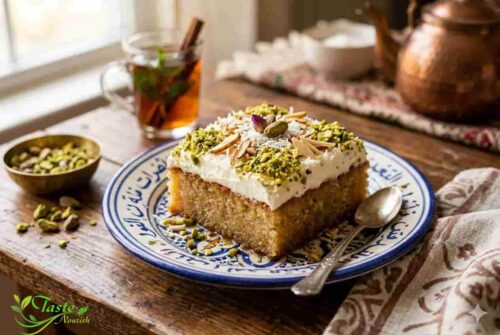
Traditional basbousa is cut into diamonds — a technique achieved by making diagonal cuts across the pan rather than straight perpendicular slices. This shape is both practical (it produces more pieces from a rectangular pan than square cuts do) and visually distinctive. For a contemporary presentation, squares or rectangles work equally well. A sharp knife dipped in warm water and wiped clean between cuts produces the cleanest edges and most visible cream stripe.
Nutrition Overview
Basbousa with cream is an indulgent dessert, and it is worth understanding what a typical serving contains. The following are approximate values for a standard serving (one piece from a 16-piece batch made according to the recipe above). Exact figures will vary based on ingredient brands and amounts used.
| Nutrient | Per Serving (approx.) | % Daily Value* |
|---|---|---|
| Calories | 380–430 kcal | ~19–22% |
| Total Fat | 18–22g | ~23–28% |
| Saturated Fat | 7–10g | ~35–50% |
| Carbohydrates | 50–55g | ~18–20% |
| Sugars | 28–35g | — |
| Protein | 5–7g | ~10–14% |
| Fiber | 1–2g | ~4–7% |
| Calcium | ~100–130mg | ~8–10% |
| *Based on a 2,000 kcal/day reference diet. Values are estimates only. | ||
Semolina is a source of complex carbohydrates and contributes modest amounts of protein and iron. The cream filling adds fat and calcium. The sugar syrup accounts for a significant portion of the total sugar content. Those monitoring sugar intake can reduce the syrup by 30–40% without dramatically changing the texture of the cake — the semolina will be slightly less moist but still flavorful.
Frequently Asked Questions
QWhat is the difference between basbousa with cream and regular basbousa?
Regular basbousa is a single-layer semolina cake soaked in sugar syrup — delicious but relatively simple. Basbousa with cream adds a distinct middle layer of thick cream (qishta or ashta), which makes it richer, softer, and considerably more indulgent. The cream layer also adds visual impact when the cake is cut, showing a clean white stripe between two golden semolina layers.
QCan I use coconut in basbousa with cream?
Absolutely. Shredded coconut is a very common addition to the semolina batter, particularly in Gulf-style basbousa. It adds a mild sweetness, a chewy texture, and a subtle tropical note that complements both the cream and the rose water syrup beautifully. Add ½ cup of desiccated coconut to the batter at the same stage as the semolina.
QWhat can I use instead of qishta if I cannot find it?
Excellent substitutes include: full-fat table cream (widely available in canned form), thick whipped cream cheese, Italian ricotta, or homemade ashta. In a pinch, full-fat sour cream can also work — it has a slight tanginess that actually complements the sweet syrup nicely. The most important attribute is thickness; the cream needs to hold its shape when spread and not dissolve into a liquid during baking.
QWhy is my basbousa with cream not moist?
The most common causes are: not resting the batter before baking (so the semolina does not fully hydrate), overbaking (which dries the cake out before the syrup can compensate), and not using all the syrup while the cake is still hot. If you follow these three steps correctly, the result should be unmistakably moist.
QIs basbousa with cream suitable for Ramadan?
It is one of the most popular Ramadan desserts across the Arab world, particularly during Iftar (the meal breaking the fast). Its sweetness and richness make it ideal for restoring energy after fasting, and it can be made a day ahead, which is practical for busy Ramadan preparations. It is commonly served alongside dates, fresh fruit, and Arabic coffee at iftar tables.
QCan I make basbousa with cream without eggs?
Yes. Eggs primarily contribute binding and structure. You can replace each egg with 3 tablespoons of unsweetened applesauce, or simply increase the yogurt by ¼ cup per egg omitted. The egg-free version tends to be slightly denser and less airy, but many traditional recipes are made without eggs and produce excellent results.
QHow long does basbousa with cream last?
When stored covered in the refrigerator, basbousa with cream stays fresh and delicious for 3–4 days. The quality actually improves on day two as the syrup fully distributes. It can be frozen for up to 2 months; thaw overnight in the refrigerator before serving.
QCan I make basbousa with cream ahead of time?
This is actually the recommended approach. Making it a day ahead gives the syrup time to absorb fully and the cream to set firmly. Many home cooks and professional caterers make basbousa with cream 24 hours before serving for the best texture and flavor.
References & Sources
- Every Little Crumb — “Basbousa with Cream” (November 2025). everylittlecrumb.com — Recipe methodology and two-stage baking technique.
- Amira’s Pantry — “Semolina Cake With Cream (Basbousa)” (2023). amiraspantry.com — Semolina types, traditional basbousa background, and ashta cream preparation.
- Sour and Sweets — “Basbousa with Cream (Hareesa Recipe)” (2021). sourandsweets.com — Homemade ashta recipe method and attar syrup guidance.
- Arla Foods UK — “Basbousa with Cream Filling Recipe.” arlafoods.co.uk — Ingredient ratios, coconut variation, and serving notes.
- Puck Arabia — “Layered Cream Basbousa Recipe.” puckarabia.com — Layering technique and pan preparation guidance.
- Dyafat Rateel — “Cream Basbousa: The Secret of the Irresistible Eastern Dessert” (2024). dyafatrateel.com — Cultural context, storage guidance, and commercial data.